01
The Cedars
- Par
- 4
- Yards
- 473
- Index
- 5
Off the terrace and away from the House. The ground falls left toward the cedars, so hold your drive into the upslope on the right.
Edward Lang, Head Professional
1 / 18Hole guide
Eighteen holes laid out in 1897 across the park of a Georgian house. Firm, walked, and played in a little over three hours.

Two loops of nine through the old park, west and east of the lime avenue, with the Head Professional’s note on every hole.
6,931 yards · Par 71 · Out 3,373 · In 3,558
Off the terrace and away from the House. The ground falls left toward the cedars, so hold your drive into the upslope on the right.
Edward Lang, Head Professional
Yardages are measured from the medal plates. Choose a set of tees to follow it across the card.
| Hole | Hole 1, The Cedars | Hole 2, Ha-Ha | Hole 3, Long Walk | Hole 4, Keeper’s | Hole 5, Dovecote | Hole 6, The Hanger | Hole 7, Icehouse | Hole 8, Lime Ride | Hole 9, Halfway | Out |
|---|---|---|---|---|---|---|---|---|---|---|
| Blue | 473 | 203 | 567 | 420 | 211 | 408 | 333 | 417 | 341 | 3,373 |
| White | 452 | 194 | 541 | 401 | 202 | 390 | 318 | 398 | 326 | 3,222 |
| Red | 393 | 168 | 471 | 349 | 175 | 339 | 276 | 346 | 283 | 2,800 |
| Par | 4 | 3 | 5 | 4 | 3 | 4 | 4 | 4 | 4 | 35 |
| Stroke index | 5 | 15 | 9 | 3 | 17 | 7 | 13 | 1 | 11 |
| Hole | Hole 10, Coach Road | Hole 11, Spinney | Hole 12, Deer Park | Hole 13, Belvedere | Hole 14, Walled Garden | Hole 15, The Mere | Hole 16, Rookery | Hole 17, Folly | Hole 18, The House | In | Total |
|---|---|---|---|---|---|---|---|---|---|---|---|
| Blue | 412 | 215 | 602 | 454 | 279 | 351 | 468 | 209 | 568 | 3,558 | 6,931 |
| White | 393 | 205 | 575 | 434 | 266 | 335 | 447 | 200 | 542 | 3,397 | 6,619 |
| Red | 342 | 178 | 500 | 377 | 232 | 291 | 388 | 173 | 471 | 2,952 | 5,752 |
| Par | 4 | 3 | 5 | 4 | 4 | 4 | 4 | 3 | 5 | 36 | 71 |
| Stroke index | 4 | 16 | 10 | 2 | 18 | 12 | 6 | 14 | 8 |
Open, all eighteen holes
Updated 6.40 this morning by Owen Pryce, Course Manager. If frost delays the start, the report changes here and on the club line, 01632 960 731, by seven.
Greens
10.5 ft
Cut and rolled, measured on the Stimpmeter at 6.30
Ask Edward Lang which holes visitors remember and he will name these two. His notes on playing them.
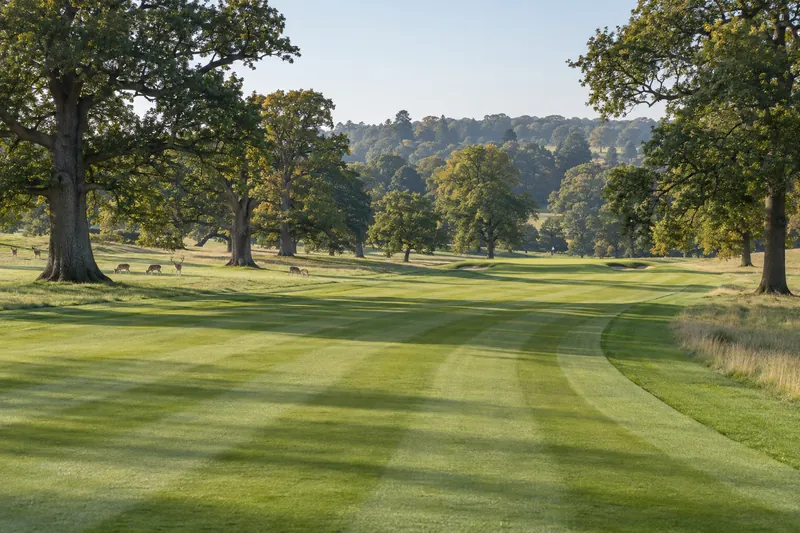
The longest hole on the card, and the one visitors are still talking about at lunch.
The fairway runs through what was the deer park, and the herd is usually somewhere off to the left. They were here first and they have right of way.
From the tee, favour the right half. The two big oaks on the left catch more drives than they deserve, and from behind them there is no way forward.
The second shot is the decision. Stay right of the last oak and you have a short iron to a long green that tilts gently toward you. Go left of it and you are pitching over the tree line.
Edward Lang, Head Professional · See the 12th on the plan

A long short hole to a green with two tiers and most of the day’s arguments.
The temple was built for the House in the 1780s, and the green was cut beneath it in 1897. You play across the hollow, and the hollow is further than it looks from the tee.
When the flag is on the top tier, take one more club than the yardage. The bank between the tiers sends anything short back down to the front, and from there two putts is a good effort.
Both bunkers are deep, the left one more so. When the wind comes off the folly, nothing stays on the top tier and the members will tell you so.
Edward Lang, Head Professional · See the 17th on the plan
Owen Pryce has been Course Manager since 2014. He and a greenkeeping team of nine are out before the first members, and the greens are cut by hand before anyone tees off.
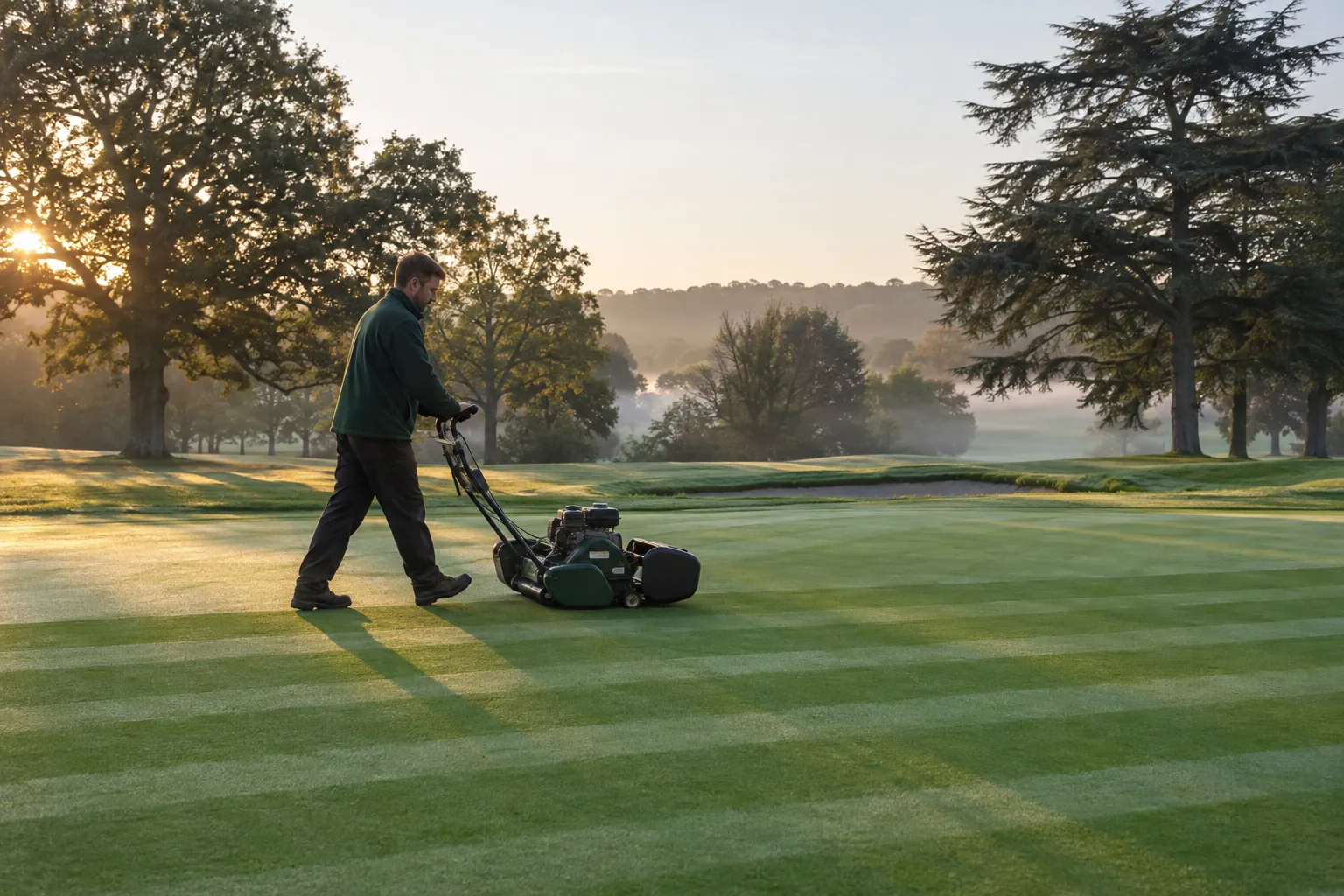
Owen PryceCourse Manager
Every member of the team plays. They are on the course at the times it matters, and they will step aside for you when you are ready to play.
The work that keeps the greens firm and true, and when it happens. Dates move with the weather; the course report always has the latest.
ScarifyingMarch
The greens are scarified to thin the thatch before the season starts, then top-dressed with sand and brushed in.
Verti-drainingApril
Solid tines go deep into the Wealden clay to let air and water through. The greens roll true again within a few days.
Greens cut every morningMay to September
Cut with hand-pushed mowers before the first tee time and rolled on alternate days. The Stimpmeter reading goes on the course report.
Hollow-tiningLate August
The one week the greens are not at their best. Cores come out, sand goes in, and the greens are back in play within ten days.
OverseedingSeptember and October
Fine fescue and bent are sown into the greens and the worn tees while the soil is still warm.
Tree workNovember to February
The oaks, limes and cedars of the park are surveyed each autumn and the work is done while the course is quiet.
Temporary greensRarely, in hard frost
Only when frost or standing water would damage the greens, and seldom for more than a morning.
These are the ones that come up. The full local rules are printed on the back of the scorecard and posted in the changing rooms, and the Secretary’s office will help with anything they do not cover.
Beyond the estate wall wherever it runs beside the course. The boundary edge is the course-side face of the wall at ground level.
The House garden, the stable yard and the car park are also out of bounds, marked by white stakes.
The sunken wall in front of the 2nd green is an integral part of the course. There is no free relief from it.
Play the ball as it lies, or take unplayable ball relief under Rule 19 with one penalty stroke.
The mere is a red penalty area. As well as the options under Rule 17, you may drop in the dropping zone short and right of the green, with one penalty stroke.
Staked trees are no play zones. If your ball lies on or touches one, or a staked tree interferes with your stance or the area of your intended swing, you must take free relief under Rule 16.1f.
From 1 November to 31 March, when your ball lies in a part of the general area cut to fairway height or less, you may lift, clean and place it once, within one scorecard length of the original spot and not nearer the hole.
You may use a device that measures distance. In a competition, any function that gauges slope, wind or club choice must be switched off.